Technically Speaking…

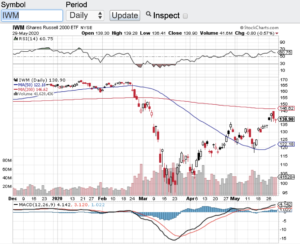
The sell-off in the markets accelerated in the month of April and technically speaking it appears there could be more selling pressure ahead. On the year, the Dow Jones Industrial Average (see chart here) is down nearly 10 percent, the S&P 500 (see chart here) is off over 13%, the Nasdaq Composite (see chart here) is down over 21% and the small-cap Russell 2000 (see chart here ) year to date is down 17%.

I am not surprised of the market weakness due to all the factors at play right now. From the war in Ukraine, to the highest inflation rates we have seen in over 40 years, the ongoing Covid backdrop albeit this dynamic appears to be improving and finally, interest rates. The Federal Reserve now has woken up to the fact that this low interest rate environment that we have lived in for over a decade is over. Runaway inflation has now become a major concern for the Fed, and they are now being beyond vocal of their intentions. A 50-basis point increase appears to be the hike here in May and hikes throughout the year are in play. In my view, this is the top catalyst as to the sell-off but let’s keep things in perspective. Last year and previous years for that matter have been a boon for stocks and pretty much every other asset class out there. Record after record have been set for years on asset classes and this is simply not sustainable. A healthy correction is beyond needed and it seems like we are in that mode now!

Now let’s look at the technical shape of the aforementioned key indexes. The Dow Jones Industrial Average (see chart here), the S&P 500 (see chart here), the Nasdaq Composite (see chart here) and the Russell 2000 (see chart here) all closed the month of April out below their key moving averages. The 20-day, 50-day, 100 and 200-day have all been breached while the Relative Strength Index aka the RSI have not yet breached an “oversold” condition. The RSI is a technical “momentum indicator” that has two values of importance. The 70-value level for potential “overbought” conditions and the 30-value level and below is a level that is considered “oversold. All the above indexes are currently hovering around the 35 level. Please remember “technical indicators” are there as a guide and a tool when assessing the technical backdrop of any given stock or index and is not 100 percent perfect.

Good luck to all 🙂

~George


Record After Record!

The U.S. stock market notched record after record in 2021! What a year for all asset classes from stocks, to real estate, to the crypto markets!

The Dow Jones Industrial Average (see chart here) finished 2021 up 18.7%. The S&P 500 (see chart here) closed the year out up a whopping 27%. The Nasdaq Composite (see chart here) closed up 21.5% and the small-cap Russell 2000 (see chart here) closed 2021 up 13.7%. How counterintuitive are these results as our country and the world for that matter continues to face and deal with Covid-19. Covid is now entering its 3rd year with the latest variant taking the world by storm. The omicron variant are causing infection rates to soar. However, scientists are hopeful that this variant could be the catalyst to ending this pandemic due to how less virulent this variant is at least to the fully vaccinated. It’s still early but the way omicron has now seemingly and abruptly reversed its course in South Africa, there is hope that this will be the case everywhere else.

Back to the markets. As we enter 2022 the big question and maybe the only question the markets have is how aggressive will the Federal Reserve be in hiking interest rates. No question in the new year interest rates will begin to head north. Inflation is soaring and impacting almost everything, which is part of the reason why we are seeing all-time highs across the board. This is not sustainable and with interest rates on the verge of increasing, stocks will face their first true test as the tightening rolls out. That said and because the pandemic is still wreaking havoc, I do not expect the Fed will be too aggressive out of the gate.

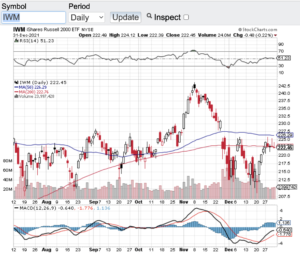
Let’s look at the technical shape of the aforementioned indexes. The Dow Jones Industrial Average (see chart here) is comfortably trading above its 100 and 200-day moving averages as is the S&P 500 (see chart here) and the Nasdaq Composite (see chart here). The small-cap Russell 2000 (see chart below) is trading at it 100 and 200 day MA so let’s see if these support lines hold for the Russell. The other technical indicator that I prefer is the relative strength index aka the RSI and none of the aforementioned indexes are in overbought territory according to the RSI. The 70 value level of the RSI is considered overbought and the 30 value level is considered oversold and each index is trading right around the middle of that range.

Happy New Year!

~George

Record After Record! - Paula Mahfouz


Strong Earnings – Record Highs!

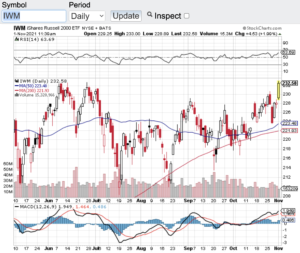
Last month I asked “Is this a healthy correction or something more?” and based on how strong earnings have been along with record highs, I think it is fair to say last months action was more of a healthy pullback than anything else. The Dow Jones Industrial Average (see chart here) is at an all-time high trading above the 36000 mark, the S&P 500 (see chart here) has also hit an all time high today, the Nasdaq Composite (see chart here) has also joined the all-time high club and the small-cap Russell 2000 (see chart here) is within striking distance of its all-time high.

The most recent catalyst for stocks and indexes hitting their all-time highs are earnings. 80 percent of the companies on the S&P 500 that have reported their Q3 earnings so far have beat Wall Street expectations. There are still 1000’s of companies set to report over the coming weeks but if trend continues we could very well be seeing more records set. Along with a strong earnings reporting season no question the Fed continues to encourage all investors to participate due to how low interest rates remain. For most investors there are not many options right now to generate meaningful returns other than the stock market or the high flying crypto space which remains incredibly volatile and extremely risky.

Now let’s take a look at the technical backdrop of the aforementioned indexes. The Dow Jones Industrial Average (see chart here) is trading comfortably above its key moving averages and not quite overbought according to the relative strength index (RSI) and the same can be said for the S&P 500 (see chart here) and the Russell 2000 (see chart below). However, the Nasdaq Composite (see chart here) has just breached the 70 value level of the RSI which is the pure definition of a stock or index becoming overbought. Note, stocks and/or indexes can remain overbought for extended periods of time before a turn.

One of the oldest adages on Wall Street is the trend is your friend and it is clear where the trend has been and where it will most likely go. That said, it is always best to consult with your certified financial planner/advisor if you are considering any portfolio additions, deletions or adjustments.

Good luck to all 🙂

~George

Strong Earnings - Record Highs - Paula Mahfouz

No June Swoon This Year…

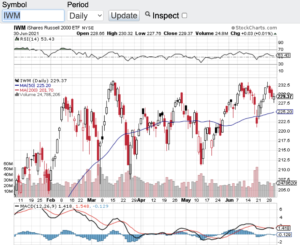
No June swoon this year, these markets are simply not having it. June historically can be either a slow month or a month of selling pressure. Neither really happened this year. Despite a brief dip in the major averages a couple of weeks back due to inflation concerns, stocks and indexes held their own last month. The Dow Jones Industrial Average (see chart here) closed out the month at 34502, the S&P 500 (see chart here) finished the month just shy of 4400, the Nasdaq Composite (see chart here) closed out the month in record territory at 14503 and the small-cap Russell 2000 (see chart below) finished the month and first half of the year at 2310.

I remain in awe of the resiliency of stocks and most every other asset class out there. I read the other day that Facebook (NasdaqGS: FB) has become the fifth company in the United States to surpass the $1 trillion value mark. We now have in our country five companies that are valued at over $1 trillion dollars. Apple (NasdaqGS: AAPL), Amazon (NasdaqGS: AMZN), Microsoft (NasdaqGS: MSFT) and Alphabet aka Google (NasdaqGS: GOOGL) round out the top five trillion-dollar companies. When I see this type of action it makes me wonder how much earnings power do these companies need to continue to exhibit in order to keep their eye-popping valuations going? One other obvious similarity is the companies are all tech stocks and that is where the real growth has been. If you go back 20 years, I don’t think anyone would of expected five companies in our markets all reaching and boasting trillion dollar plus valuations. Heck, Microsoft’s market cap just surpassed $2 trillion dollars to join Apple as the only companies with more than a $2 trillion dollar valuation. Folks I am not a forensic analyst, but my goodness how is the law of large numbers playing a role here?

As I look at the technical shape of the major averages nothing really stands out to me with the exception of the Nasdaq Composite (see chart here). The Nasdaq has just entered overbought territory according to the relative strength index aka the RSI. The Nasdaq also just hit an all-time high so I think some sort of pullback could potentially be in the offing.

Have a safe and happy 4th of July weekend 🙂

~George

No June Swoon This Year - Paula Mahfouz


Risk On Remains On!

Risk on in the markets remains on as we approach the second half of the year! It’s truly remarkable to me how stocks, crypto, real estate and other asset classes are still trading at or near all time highs. I do get that the ongoing accommodative policies provided by our Federal Reserve and from central banks across the globe is the main reason why asset prices continue their bullish ways.

That said, I do think it is time to start considering how things could look once the Federal Reserve in our country starts backing away from its accommodative monetary policies and as interest rates begin to normalize. This is not a question of if, it’s a question of when. Tell tale signs of inflation are now seemingly everywhere which is what the Federal Reserve is paying close attention to and could be the catalyst for the Fed to act. It is at this point our markets could be adjusting to align with real interest rates and normalized price to earning multiples. To that end, we have and continue to witness the most unique market conditions ever seen. So I am not calling a top here and I do respect the power of the Federal Reserve, however, I am just suggesting that we may see a healthy and overdue adjustment in asset prices which may not be such a bad thing. There are many investors that are on the sidelines and would be more than happy to step in should we see asset prices adjust to a lower entry point.

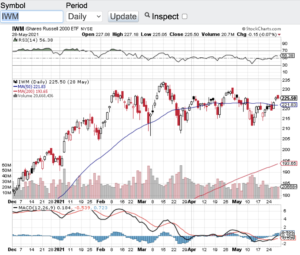
Let’s take a quick look at the technical shape of the major averages. The Dow Jones Industrial Average (see chart here), the S&P 500 (see chart here), the Nasdaq Composite (see chart here) and the Small Cap Russell 2000 (see chart below) all are trading above their 20, 100 and 200 day moving averages. This alone is a strong technical backdrop and what’s more is none of the aforementioned indexes are currently overbought according to the relative strength index aka the RSI. So technically speaking things look pretty good right now.

Good luck to all 🙂

~George

Risk On Remains On - Paula Mahfouz


Big Tech Blowout!

Big tech absolutely blew out their earnings in their most recent quarter. Let’s start with Apple; Apple (NasdaqGS:AAPL) experienced growth in each of its product categories. What’s truly unbelievable is Apple generated about a $billion dollars a day in revenue. Yes, no typo folks, a billion a day in revs in their most recent quarter. Facebook (NasdaqGS: FB) also crushed their quarter generating over $26 billion in revenues easily beating analysts expectations of $23 billion and Facebook’s earnings per share exceeded analysts’ expectations by 40%. Alphabet’s (NasdaqGS: GOOGL) quarter was also quite stellar posting revenues of $55 billion which is up over 30% from the same period a year ago and last but not least Microsoft (NasdaqGS: MSFT) posted revenue of over $41 Billion up almost 20% over for the same period last year. To me this is breathtaking on how these mega-cap companies continue to grow at such a high clip completely ignoring the “law of large numbers” .

So off to the races for the aforementioned stocks right? Not so fast. Despite popping after releasing their earnings, these stocks have started to trade lower. This could be a sign that these earnings reports were already baked into the price already. Of course, it is not uncommon for stocks to become a bit exhausted especially after the tear that the markets have been on so far this year. Let’s see how next week fares in whether or not the lack of follow through to the upside now that earnings are out.

As I look at the overall technical shape of the markets the Nasdaq Composite (see chart here), the Dow Jones Industrial Average (see chart here), the S&P 500 (see chart here) and the small-cap Russell 2000 (see chart here) are not currently overbought according to the relative strength index. What’s more is these indexes also remain comfortably above their respective 100 and 200 day moving averages and are finding current support at their 20-day MA.

Good luck to all 🙂

~George


2021 Is Here…

2021 is here and it could not of come fast enough. Happy New Year and I think we can all use a fresh start! The year 2020 was one of the most challenging years our country and the world has faced. One of the only exceptions that did not face many challenges is the stock market. Despite the global pandemic we remain in and the non-stop chaos out of Washington DC, the major averages set record highs throughout the year. Who would of thought that stocks and market speculation would be at such a fever pitch considering the backdrop of 2020. During this latest bull market surge one thing that stands out to me is how margin debt has hit all time highs. Investors have borrowed over $700 billion dollars against their portfolios which is also a new record. This is somewhat alarming because when the market experiences a correction, margin debt can accelerate any meaningful selloff. Some investors could be forced to sell if their margin debt becomes disproportionate to their overall account value. That said, when record highs continue to be set the risk of margin debt tends to be overlooked.

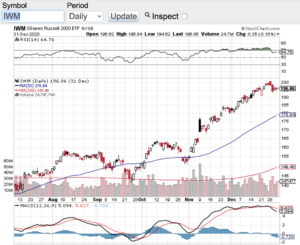
Speaking of record highs, both the Dow Jones Industrial Average (see chart here) and the S&P 500 (see chart here) set new records on the last trading day of the year. The Nasdaq Composite (see chart here) and the Russell 2000 (see chart below) also set records earlier in the week. Although stocks and indexes feel overbought, we are not seeing extreme overbought conditions according the the relative strength index also know as the RSI. There is also support in place at the 20-day, 50-day, 100 and 200-day moving averages. So technically speaking the key indices appear to be in good shape. This set-up bodes well for the continuation of the market rally that we are in.

Of course there are risks out there that could temper the record setting enthusiasm. One risk in particular is the upcoming runoff election in Georgia next week. If the democrats take control of the Senate, this could be viewed as a negative for stocks. The markets historically have liked when there is a split majority between the House and Senate. Pundits argue that a Democratic President and a Democrat controlled Congress could affect income and capital gains taxes that would negatively impact stocks. I am not sure if this will play out but nonetheless as we continue down this bull market path we should not be lullabied to sleep with the risks out there. Good luck to all 🙂

~George

2021 Is Here - Paula Mahfouz

A Breakout Or A Fake-out?

The major averages seemingly are on the verge of a breakout, or could it be a fake-out? The Dow Jones Industrial Average (see chart here) has recaptured the 25000 level. The S&P 500 (see chart here) has recaptured the 3000 level. The Nasdaq Composite (see chart here) believe it or not is in striking distance of its all-time high and the small-cap Russell 2000 (see chart below) is also setting up for a breakout on its own. It is beyond impressive how the markets have come roaring back since late February. There are certain pundits out there that believe that this is a classic bear market rally however to me it feels like more than that. I have to believe that one of the main reasons why stocks have come roaring back in such a short period of time is the $ trillions of dollars in liquidity that the Federal Reserve and our government has injected into the markets and the economy. In fact, the Federal Reserve has quietly indicated that it is possible that they themselves would buy stocks if needed. Talk about establishing a floor in the stock market!

Another key development in the markets is how strong the technicals look right now. Without a doubt the leadership group of this recent rally is the Nasdaq Composite (see chart here). Tech stocks have benefited the most due to the lockdown. There are more people online than ever before, hence more sales accordingly. Since mid-April, not only has the Nasdaq cleared its 200-day moving average, it also has cleared its 50, 100 and 20-day moving averages. So now the Nasdaq is trading above all of its key moving averages which is bullish. Furthermore, the Dow Jones Industrial Average (see chart here) the S&P 500 (see chart here) and the small-cap Russell 2000 have also broken above some key technical resistance levels. Another technical indicator I look at the relative strength index also known as the RSI. At this point in time the aforementioned indexes are not in overbought territory. The RSI is a momentum indicator and when the value level of the RSI goes above 70 stocks or indexes begin to become overbought. This is currently not the case.

Good luck to all 🙂

~George

A Breakout Or A Fake-out - Paula Mahfouz


Fear Of A Global Pandemic Grips Markets!

Stocks went into a tailspin as fear of a global pandemic grips the markets! New outbreak clusters of the highly contagious coronavirus are beginning to surface which is pressuring leaders from around the world to act and act more aggressively. Stocks have also entered correction territory as companies and analysts begin to ratchet down their revenue and earning forecasts. Over the past week or so the Dow Jones Industrial Average (see chart here) has lost over 10% in the past week alone, the S&P 500 (see chart here) has also entered into correction mode, the Nasdaq Composite (see chart here) has been hit hard and the small-cap Russell 2000 (see chart here) is also witnessing a sharp sell-off.

Personally I believe a correction was needed because of how robotic the markets have acted. Stocks no matter what risks were out there behaved in a way never before seen. We have been in the strongest bull market ever and nothing over the past 12 years could slow this bull market down. Now I am not happy that it is a global health risk that’s the catalyst to put stocks in correction mode, but nonetheless this is where we find ourselves. Of course when fear is rampant in any market this is where opportunity can be found. I am not suggesting to jump in here because as we all know fear and/or greed can be excessive and markets tend to over do it when emotions take the lead over rational thinking. So when we get overextended to the upside or downside the first thing I look at is how the technicals look during extreme market moves.

When I now look at the technical shape of the markets at least at it pertains to the moving averages things do not look so good. The Dow Jones Industrial Average (see chart here), the S&P 500 (see chart here) and the Russell 2000 (see chart here) have all breached their 20-day, 100-day and 200-day moving averages which are all seen as major support zones especially the 200-day. The Nasdaq Composite (see chart here) is the only major index that has yet to close below its 200-day. That said, all of the aforementioned indexes are oversold according to the relative strength index (RSI) which when we see the 20 value level hit on any stock or index, snap back rallies can and do occur. This type of market is great for traders if you are experienced enough to trade off of technicals, however for investors that have a long term view these type of market environments requires a lot of patience and keeping the emotions at bay. Let’s all hope that the spread of the coronavirus abates and that a vaccine becomes available as quickly as possible.

Good luck to all 🙂

~ George

It’s A Broken Record!

It’s a broken record indeed! That is the continuing record breaking run on Wall Street. On Friday the Dow Jones Industrial Average (see chart here), the S&P 500 (see chart here), the Nasdaq Composite (see chart here) set new all time highs. Seemingly, there is no stopping this record setting run that the markets have been on, at least for now. The latest catalyst was news out of Washington that the U.S. and China are close to coming to a “Phase 1” agreement on a trade deal. As I eluded to in my November 15th blog, new record highs could come into play by year-end if we see a trade deal happen. The caveat here is the deal is being titled as a “Phase 1” agreement and there is much more to agree upon to finish the deal out. That said, this is a definite step in the right direction and the markets seem to agree. I do want to keep my enthusiasm in check because of the volatility that continues to come out of Washington on this subject. We have all seen over the past several months tweets and statements out of Washington that we are close to a deal with China to only then wake up the next day to get the opposite statement either out of Washington or China. Phase 1 is a great step, but I am looking forward to the complete deal getting done and most likely that will yield to the first quarter of 2020.

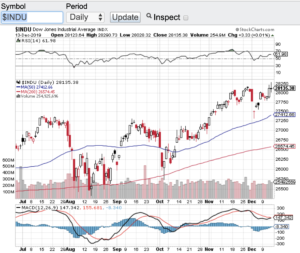
In the meantime, investors are continuing to enjoy record highs and there doesn’t seem too much ahead between now and year-end that will change the course. The technical shape of the bellwether indexes remain intact. The Dow Jones Industrial Average (see chart below), the S&P 500 (chart) and the Nasdaq Composite (chart) are all trading below the 70 value level of the relative strength index (RSI). Also, each of these indexes are trading healthily above their 20, 50, 100 and 200 day moving averages.  

Paula and I wish everyone a very safe and happy holiday season.

~George

It's A Broken Record! - Paula Mahfouz