What Bear Market?

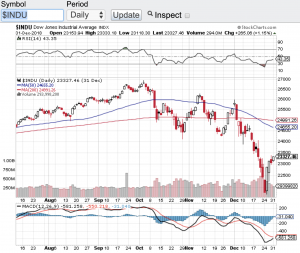
The major averages in December entered into bear market territory and seemingly was heading even lower. But lo and behold and fast forward to today and we see that the key indices have all come roaring back.ย  The definition of a “bear market” is when a stock or an index goes down 20% or more from its highs and that was definitely the case in the second half of 2018. The Dow Jones Industrial (see chart here) is now back over 24,000 after dropping below 22,000 in December, the S&P 500 (see chart here) is back over 2,600 after dropping below 2,400, the Nasdaq Composite (see chart here) is now over 7,100 after hitting a low of 6,190 and the small-cap Russell 2000 (see chart here) it trading above 1,400 after hitting a low in December of 1,267.

The sharp V shaped bounce back in such a short period of time is very impressive. I do not think anyone expected such a sharp rebound in just a month. This surprise move is also happening despite the ever increasing chaos and turmoil out of Washington DC. Is it me or has it gotten to the point of utter disgust with what is happening to our country. I am not much of a political advocate in either direction but the narcissism and antics coming out of DC is unbelievable. What’s more is that they are using the government shutdown as the pawn to get their way, again unbelievable.

Ok enough of that and back to the markets. We are now heading straight into earnings reporting season and to me this without a doubt will be a significant catalyst as to whether or not stocks will continue to rise or pause. Of course any type of meaningful progress with the trade war and China could also play a major role. The Federal Reserve has been more vocal with interest rates and indicating that they are more apt to more of a wait and see approach as to any additional rate hikes in near term. There is a lot at hand here which should determine whether or not this bounce back rally will continue. Good luck to all ๐Ÿ™‚

~George

Happy New Year!

Happy New Year! Well if you have been long the markets and with the way stocks closed out 2018, it wasn’t so happy for the bull camp. However, a new year means new beginnings :-). Let’s do take a gander to see how the major averages fared in 2018. The Dow Jones Industrial Average ( click here or see chart below) finished the year down 5.6%, the S&P 500 (chart) closed the year down 6.2%, the Nasdaq Composite (chart) closed down 4% and the small-cap Russell 2000 (chart) closed 2018 down 12%. This is the worst performing year for stocks in a decade.

So what happened? In my view and simply put how can stocks go up in a straight line for over a decade without a correction? That’s right, stocks essentially have gone up for over 10 years’ without a healthy 20% correction. So when the markets finally had a real correction which is what occurred in the 4th quarter, it felt like the sky was falling. No question the Federal Reserve and rising interest rates have played a role in the market correction, however, let’s keep this in mind a 2-2.5% Fed funds rate is still historically low. What wasn’t normal over the past decade was a 0 percent interest rate policy and no market volatility. Everyone got spoiled with such an accommodative policy and market environment.

Another factor playing into the mix of the Q4 market correction is without question the trade war and tariffs that our President has ignited. This to me is even more of an issue to our economy than rising interest rates lifting to a normalized level. Not only is the trade war and its ramifications playing a role, but the inconsistency and chaos out of Washington are wreaking havoc on the markets.ย  No doubt in my mind that investors and Wall street are falling out of love with how our country is being governed, especially over Twitter. This is all fixable, we will just have to wait and see if the ego’s and the political agendas on both sides of the aisle can get the confidence back in our marketplace. Paula and I wish everyone the happiest and most prosperous 2019.ย  Good luck to all ๐Ÿ™‚

~George

Dow Jones Industrial Average - George Mahfouz Jr

Undeniable Market Correction!

Despite this morning’s relief rally, stocks and indexes are either in an undeniable market correction or in an actual bear market. Healthy corrections are 10% or so declines, bear markets are defined by a 20% or more of a decline. This is where the small-cap Russell 2000 (click here for chart) finds itself and that is in a bear market. The Dow Jones Industrial Average (chart) is not quite in bear market mode nor is the Nasdaq Composite (chart) or the S&P 500 (chart). However, these indexes have lost over 6% of their value in December alone. Not since the great depression has the markets been hit this hard in the month of December. Furthermore, market sentiment has not hit this low since the 2008 crisis either.

So what is going on? The default answer to this question is the Federal Reserve and rising interest rates. The Fed actually meets tomorrow to decide on whether or not to raise by a quarter point. I think what’s even more important than whether or not they hike rates, it’s how dovish or hawkish they are in their testimony. I have to believe with how sharp and how fast stocks have corrected they may lean towards the more dovish spirit with a wait and see approach before raising rates again. The other default answer as to why stocks have been beaten down is the confusing messages that constantly flow out of Washington, especially as it pertains to the China trade war. The markets hate to be confused by policy makers especially our President and instead of holding on, clearly investors and traders alike have been dumping stocks for weeks now. If the Fed communicates their intentions clearly and if Washington is capable of doing the same, this could be just a market correction. If not, then I think we could see all of the aforementioned indexes fall into bear market territory. Good luck to all:-)

~George

Historically A Strong Month For Stocks…

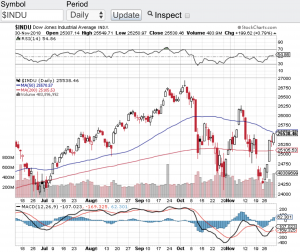
December is historically a strong month for the stock market. Many factors play into the last month of the year being a positive one including holiday bonuses, the general overall feeling of optimism and typically lighter volumes due to the holiday season. How we finish out this year will largely hinge on the results of this weekend’s G20 summit. Early indications are that the trade talks and other collaborative measures are going well. As the major averages enter into the last month of the year, The Dow Jones Industrial Average (click here for chart) finds itself at 25,538, the S&P 500 (chart) closed out the month of November at the 2,760 level, the Nasdaq Composite (chart) finished at 7,330 and the small-cap Russell 2000 (chart) finished November at 1,533. On the year, the major averages are barely in the green with the small-cap Russell 2000 actually a tad in the red.

Stocks this past week did get a boost from Federal Reserve Chairman Jerome Powell when Chairman Powell spoke at the Economic Club of New York. Chairman Powell stated that the Fed’s benchmark interest rate was now “just below” the neutral level. This sent the Dow Jones Industrial Average (see chart below) soaring over 600 points on Wednesday. Chairman Powell’s comments are being viewed by the street that the Federal Reserve just might be done raising interest rates for the foreseeable future. Now if we can get some concrete positive news and developments out of the G20 summit which is being held in Buenos Aires, then indeed we could be setting up for a year-end rally.

Let’s take a look at the moving averages technical set-up of the aforementioned key indexes starting with the Dow Jones Industrial Average (chart). At Friday’s close, the Dow is trading above its 200-day moving average by about 400 points while the S&P 500 (chart) closed right at its 200-day. Both the Nasdaq Composite (chart) and the small-cap Russell 2000 (chart) are trading below their respective 200-day moving averages but they have recently cleared and are trading above their 20-day moving averages.ย So technically speaking things do not look too shabby. Let’s see if we can have a rally into year-end.

Good luck to all ๐Ÿ™‚

~George

Dow Jones Industrial Average - George Mahfouz Jr

Tariffs and Interest Rates…

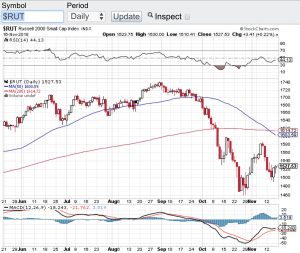
Tariffs and interest rates are at front and center. Now that Q3 earnings reporting season is winding down, without question the two remaining catalysts for these markets between now and year-end areย  tariffs and interest rates. It’s been a long time since we have seen the swings that are going on right now in the stock market. Investor’s and trader’s alike are attached to every headline or tweet pertaining to the current trade war between China and the U.S. and whether or not the Federal Reserve will take its foot off of the pedal. The growing tensions between China and the U.S. regarding tariffs did abate late Friday when President Trump tweeted that China does want to make a deal. This was enough to rally the markets on Friday afternoon, but not enough to get the the key indexes out of the red on the week. On the week, the Dow Jones Industrial Average (chart) closed at 25,413, the S&P 500 (chart) closed at 2,736, the Nasdaq Composite (chart) closed at 7,248 and the small-cap Russell 2000 (see chart below) finished the week out at 1,527.

With the aforementioned looming catalysts on the horizon the big question is will we get a year end rally? My feelings are we may only need one of these catalysts to come through for a potential year-end rally. If China and the U.S. can agree upon more favorable terms to the imposed existing tariffs and/or actually withdraw some of the existing tariffs, we may have a shot. Not to say interest rates aren’t important, but relatively speaking interest rates still remain historically low. Even if the Federal Reserve raises rates in December, I still think that a China U.S. deal would be enough for a rally as we close out 2018. The G20 summit is just two weeks away and let’s hope some sort of deal can come forward out of the summit. Good luck to all ๐Ÿ™‚

~George

Russell 2000 - Paula Mahfouz


A Long Overdue Correction!

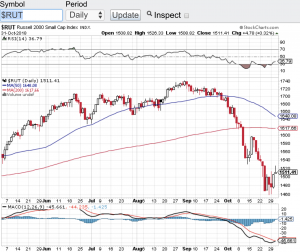
It was a spooky time for the equity markets in October as stocks experienced a long overdue correction. You have to go back seven years to have a month that sold off in the way the markets behaved in October. Yes, historically October has been one of the most volatile months of the year. The problem with historical data over the past several years is most of the time history has NOT repeated itself. Stocks have been on a tear for years breaking record after record. In fact not that long ago all of the major indexes had set all time record highs. Fast forward to today and we find the Dow Jones Industrial Average (chart) down almost 7% from its recent all-time high, the S&P 500 (chart) actually fell at one point over 10% from its all-time high finishing the month of October down 8%, the Nasdaq Composite (chart)ย  is down over 10% from its recent all-time high and the small-cap Russell 2000 (see chart below) is off over 13% from its all-time high recorded on August 31st of this year. So I think it is safe to say most of the market is in correction mode.

Next question, is this a healthy correction for the markets and will stocks find their bottom here or could this be the start of our first bear market in a decade? I guess the answer depends upon who you ask. I think it is too early to call out that a bear market is in the making, but one thing is for sure, we have not seen sustained volatility as we have witnessed recently in a very long time. As long as the trade war rhetoric continues to spew out of Washington and as long as the Federal Reserve keeps its foot on the gas pertaining to interest rates, I think the wild swings and volatility will continue. Oh yea, there is also this small event next week called the “mid-term elections” which should also play a key role in continuing vol. Good luck to all ๐Ÿ™‚

~George

Russell 2000 - Paula Mahfouz

Finally A Market Selloff!

In my last blog, I eluded to a market selloff that just did not happen and I was referring to how stocks typically behave in the August and September. Instead of markets selling off at the end of summer, stocks were setting records. Well the bears got what they had been anticipating over the summer and that is an eye-popping market drop last week. Over the course of two days the Dow Jones Industrial Average (chart) fell over 1300 points. Of course the S&P 500 (chart), the Nasdaq Composite (chart) and the small-cap Russell 2000 (chart) all fell in harmony as well. What’s more these bellwether indexes all breached their 200-day moving averages for the first time in months with the Dow Jones Industrial Average (chart) recapturing and closing above its 200-day on Friday, the Nasdaq Composite (chart) just closed shy of its 200-day, the S&P 500 (chart) literally closed right at its 200-day however, the small-cap Russell 2000 (chart) closed out last week meaningfully below its 200-day moving average looking to find some sort of support. The 200-day moving average is widely regarding by market technicians and institutional investors as a key metric of support and or resistance.

What does all this mean? First, a market that constantly goes up with no retracement to speak of can never be healthy long term. There must be backing and filling along the way so that the risk of a sudden and potentially drastic drop doesn’t occur as what we witnessed last week. I mean c’mon going up in the way that we have over the past decade is not only unheard of but the risk that can come forward from this can spark a nasty correction. I am not suggesting that this will be the case but for the first time since earlier in the year, investors and traders felt the selloff last week.

Earnings reporting season kicks in this week with hundreds of companies set to report. Let’s see if corporate earnings can buoy the market here during this long anticipated selloff. Good luck to all ๐Ÿ™‚

George

A Market Selloff That Just Did Not Happen…

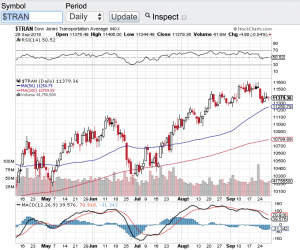
As summer ended where was the market selloff? Instead of conforming to what historically are the weaker months of the year whereas stocks at the very least should of paused with lighter volumes, the major averages hit all time highs. The Dow Jones Industrial Average (chart), the S&P 500 (chart), the Nasdaq Composite (chart), the small-cap Russell 2000 (chart) and even the Dow Jones Transportation Averageย (see chart below) all hit record highs in the third quarter. In fact the broad based S&P 500 (chart) turned in its best quarterly performance in five years. In my previous blog, I spoke to how traders and investors alike are awaiting a September selloff but seemingly nothing can stop this perma-bull market! Not trade wars, not interest rates, not the threat of inflation, not the daily chaos out of Washington, not historic seasonality, I mean nothing has stopped this bull market. Without a doubt this has been a close your eyes and a “go long” market. If you just did that over the past decade, you would of been part of 100% plus gains and whoever did do that, congratulations!

So now begs the question of what now? What now is fourth quarter earnings reporting season and oh yes the mid-term elections! October will not only be loaded with corporate earnings reports but there is also this little event call mid-term elections. I think it is safe to say that at the very least volatility shouldย  rear its head up. As the summer trading months were unfolding vol went back to its “low vol” standard as we have witnessed for past decade. There is just no fear in the markets. The volatility index aka the VIX (chart) is a measure of investor fear and in this case, lack thereof. I have got to believe that volatility will increase as we head into earnings reporting season and especially as we approach mid-term elections. Good luck to all! ๐Ÿ™‚

~George

Dow Jones Transports - George Mahfouz Jr

Traders And Investors Are Awaiting A September Selloff…

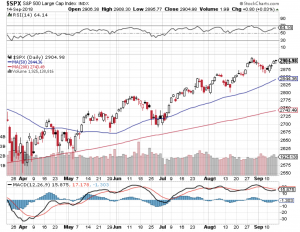
Traders and investors are awaiting a September selloff that actually may not come. Stocks continue to demonstrate strength and resiliency despite the political turmoil in Washington DC, rising interest rates and a seasonality headwind that just isn’t happening. August and September are typically weaker months for the stock market, instead the S&P 500 (see chart below), the Nasdaq Composite (chart) and the small-cap Russell 2000 (chart) hit all-time record highs and the end of August and despite a mini pullback shortly thereafter, the markets appear to have stabilized near all time highs. The Dow Jones Industrial Average (chart) did not make an all-time high in August, however, this index remains within striking distance of its all time high. The pundits are speaking to the strength of corporate America where earnings and profits are at their highest levels in decades as to the reason why the markets are not selling off. What is undeniable is that any time stocks have experienced a pull back it has been met with support from institutional investors and retail investors alike.

Speaking of support, let’s take a closer look at the technical shape of the aforementioned key indexes. Let’s start with the S&P 500 (chart). After pulling back to its 20-day moving average the S&P is right back at a breakout point. Next week we should see if the S&P can indeed breakout or fail and head back to its 20-day. The Nasdaq Composite index (chart) has similar chart pattern although it traded a bit below its 20-day support line for a few days before recapturing its 20-day and is now trading above it. A look at the Russell 2000 (chart), it too closed above its 20-day moving average and last but not least the Dow Jones Industrial Average (chart) also closed above its 20-day and this index is also right at a breakout or breakdown point. These bellwether indexes are also not in an extreme overbought condition according to the Relative Strength Index. The RSI tracks overbought or oversold conditions and is a momentum indicator that measures the degree and velocity of recent price changes to determine what is overbought and what may be oversold. We are simply not in any extreme condition according to the RSI principle.

Let’s see how the back half of September plays out and we will revisit the technical set-up of the markets in October. Good luck to all ๐Ÿ™‚

~George

S&P 500 - George Mahfouz Jr


Bellwether Indexes Surge To All Time Highs!

Bellwether indexes surge to all time highs as the S&P 500 (chart) closed the month of August at 2901, the Nasdaq Composite (chart) closed at 8109, the small-cap Russell 2000 (chart) closed at 1740 and the Dow Jones Industrial Average (chart) is within striking distance of its all time high. I thought August is supposed to be a tough month for stocks? Not this year! New highs are happening while the political environment in our country is at a seemingly all-time low, the word impeachment surfaces daily now, tariffs are in the headlines daily, interest rates have been on the rise and now it seems that any type of progress made over the summer with North Korea may be in jeopardy. One would think that the aforementioned risks would be enough for an outright 10-20 percent market correction. Add in the seasonality factor and we should indeed be going red, not making all-time highs.

Now I am afraid to even mention that the month of September is historically the weakest month of the year for stocks right alongside with August. Do I dare say that September will be the month that our markets correct in a meaningful way? Do I have the courage to predict that this will be the month where the markets recognize and adjust for all of the risks that are present in our current environment? I don’t know people, I am as baffled as the next guy as to how these markets keep shrugging off real market issues. Oh by the way I forgot to mention we have mid-term elections forthcoming, the markets are not pricing in any risk there either. These markets are priced and acting like there is no absolute risks at all out there. Ok enough banter already!

How to play the markets now? I am a fan of the old adage “the trend is your friend” but folks I just can’t hop on this train at this point in time. I am heading to the sidelines until I see any type of technical breakdown to possibly consider implementing a short thesis or just wait for the inevitable pullback/sell-off to identify any potential long set-ups. Until then, Paula and I wish everyone a very safe and Happy Labor Day weekend ๐Ÿ™‚

~George