Finally A Tradable Market!

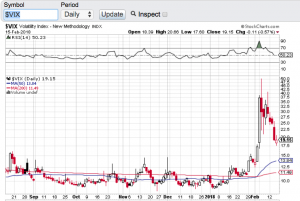
After years of essentially low to no volatility, traders finally get what they have been wishing for and that is a tradable market! In 2017 the markets witnessed the longest stretch of low vol in recent memory. In fact the VIX (see chart below) which is the ticker symbol for the Chicago Board Options Exchange volatility index traded in the 10 zone for most of 2017. The 10 level on the VIX (chart) is beyond abnormally low especially lasting for the better part of a year. Fast forward to today and the VIX is hovering around 20 after spiking to over 50 over the past two weeks. We haven’t seen the VIX (chart) at the 50 level in years. Call it long overdue, call it the market needed to correct, call it higher interest rates, call it what you want but finally we seemingly have more of a normal market environment. Not to say it wasn’t gut wrenching watching 1000 point Dow Jones Industrial Average (chart) intra-day swings over the past couple of weeks compared to the slow melt-up investors have enjoyed for years. Traders on the other hand have underperformed the markets during the melt-up because there simply was not enough or no volatility to be able to trade.

Stocks have indeed bounced sharply from the early February market correction. The Dow Jones Industrial Average (chart) closed the day up 307 points, the tech focused Nasdaq Composite (chart) closed up on the day 113 points, the S&P 500 (chart) closed up 32.5 points and the small-cap Russell 2000 (chart) finished the trading session up 15 points. Going forward I am certainly going to respect the technical make up of the aforementioned indexes and select stocks. Moving averages such as the 20-day, 50-day and 200-day tend to provide reliable support and resistance marks and now that we are out of the no vol environment, these moving averages tend to be more accurate and can be used to determined entries and exits in positions you hold and or trade. As I write this blog the key indexes have now rebounded to their 50-day moving averages so we will see if this technical indicator will act as resistance or if the markets can hold, breakthrough and proceed higher. Of course there is much more to consider when entering or exiting any position or strategy but when volatility comes back into the markets, most professional traders key in on the moving averages. Good luck to all šŸ™‚

~George

VIX - Paula Mahfouz

An Earnings Bonanza!

Earnings reporting season is now in full swing and so far the numbers are not too shabby. A couple of earnings standouts so far are Netflix (NasdaqGS: NFLX) and Boeing (NYSE: BA). Netflix saw subscriber and revenue growth both exceed analyst’s expectations and their stock has skyrocketed since their earnings release last week. Boeing which reported before the bell yesterday also knocked the cover off the ball as the company nearly doubled its net income from the prior period a year ago. A company doubling its net income may not sound like a lot, but when you go from $1.63B in net income to $3.13B that is clearly moving the needle in a fascinating way. Boeing shareholders were also rewarded yesterday as the stock traded north of $350.00 per share hitting all-time highs. I am just highlighting a couple of standouts so far with hundreds of companies set to report over the coming days and throughout the next few weeks.

After a 2 day mini sell-off to start the week the key indexes did bounce back yesterday and resumed itsĀ  uptrend. The Dow Jones Industrial AverageĀ (chart) closed the month of January above 26,000, the S&P 500 (chart) closed out the month at 2823.81, the Nasdaq Composite (chart) closed at 7411.48 and the small-cap Russell 2000 (chart) closed at 1575. Even with the first noticeable sell-off earlier in the week the aforementioned indexes did have a stellar performance in January gaining more than 5% on the month.

I will say this, earlier in the week and for the first time in almost 2 years the market did feel vulnerable and the sell-off felt a bit different than recent pullbacks. Pundits are suggesting that interest rates may be playing a role in the volatility for the first time in years. I have been tracking the yield on the U.S. 10 year Treasury Note (Symbol: TNX) and for the first time in a long time the yield exceeded 2.7%. A break above 3% for an extended period of time could cause volatility to continue in stocks and may be the very first catalyst to put the brakes on this almost decade long bull run. Let’s see how the rest of earnings reporting season plays out and how interest rates fare in February before we can draw any type of conclusion. Good luck to all šŸ™‚

~George

Dow 20,000!

There has been plenty ofĀ chatter over the past month or so as to whether or not the Dow Jones Industrial Average (chart) would surpass the 20,000 mark and what that would mean for the markets going forward. Well lo and behold, it did it! For the first time in its history, the Dow Jones Industrial Average (chart) breached the 20,000 milestone mark last week thanks in part to earnings reporting season. The Nasdaq (chart) also continues to set record highs although this week this particular index has recently been challenged by DonaldĀ Trump’s commitment to altering the H-1B visa rules which in turn couldĀ effect the tech industry in a meaningful way. The S&P 500 (chart) also remains near its all-time highs while the small-cap Russell 2000 (chart) is hovering around its 50-day moving average.

While earnings reporting season remains a key focus for investors, one cannot ignore the constant daily flow of news out of Washington D.C. President Donald Trump like no other has signed double digit executive orders in his first week of officeĀ alone fulfilling part of his campaign pledges. These executive orders range from loosening regulations in a variety of industries, to border security, to withdrawing the United States from the Trans-Pacific Partnership Negotiations agreement and to the construction of the Keystone XL pipeline, just to name a few. Without question Donald Trump means business and is acting swiftly about it. We know how the American public feels about this and most recently how corporate America is beginning to speak out, and it’s a mixed bag to say the least.

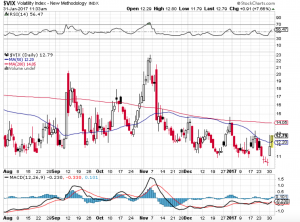
The question now is how will the markets ultimately react to the new norm,Ā the protectionism posture of the new administration and the swift policy changes that are occurring? Well for the first time in a while market volatility (see chart below) hasĀ spiked as investors and traders alikeĀ try to digest the ultimate outcomes of such dramatic changes. In my humble opinion, vol is just getting started. Good luck to all šŸ™‚

~George

Dow 20,000 George Mahfouz Jr

Quietly The VIX Elevates…

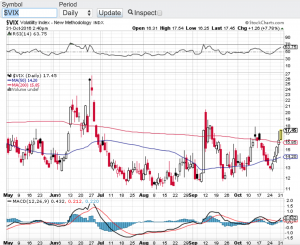
Over the past week the CBOE Market Volatility Index aka the VIX (see chart below) has risen over 35%. Not too surprising considering the upcoming elections and the daily rhetoric that has been hitting the wires. What is surprising to me is that even though volatility has spiked recently, the markets have not really dropped. Isn’t how this is supposed to work? Increase in vol equals lower stock prices? The Dow Jones Industrial Average (chart), the S&P 500 (chart) and the Nasdaq (chart) all remain within striking distance of all-time highs and so far these key indicesĀ do not seem to be too bothered by the daily political headlines. Even Friday’s surprising if not shocking newsĀ that F.B.I. director James Comey has re-opened the Hillary Clinton email case could not rattle the markets. Although this particular headline did send stocks sharply lower in the late afternoon trading on Friday only to find support and close off of the lows.

I will say this; I am even more surprised that yesterday we did not see a sell-off in stocks after everyone had time to digest the news over the weekend. Stock market pundits continue to claim that the markets have priced in a Clinton victory andĀ that her taking the White House in general will be bullish for stocks. I tend to agree with this however; my concern is will this be a “sell the news” event? I will also be paying closer attention to the polls this week to see if the Trump campaign closes in on the Clinton lead. This too can be a market moving dynamic. So asĀ the VIX continues to lift and as we get closer to November 8th, I will error on the side of caution and lighten up any long positions and wait to see how this election plays out. Let’s also see how the markets react and respond to the election results and thenĀ come up with a game plan into year-end. Good luck to all šŸ™‚

~George

VIX chart George Mahfouz Jr

As Promised, Vol Is Back!

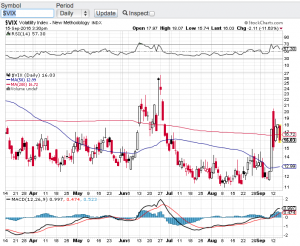
We knew it was only a matter of time. After trading in the most narrow range for the better part of the summer the VIX (see chart below) which is the ticker for the Chicago Board Options Exchange Volatility Index spiked this week over 60%! Ā This on fears that monetary policy changes are forthcoming here in the United StatesĀ and abroad, especially as it pertains to interest rates. How is this a surprise though? There is not a day that goes by, in fact there is not an hour that goes by without headlines coming out pertaining to the Federal Reserve and what they will or will not do with interest rates.

Look my view is simple, count on it! Count on central banks changing their position on interest rates at some point in time. What amazes me is how much the markets and investors have become so reliant and seemingly make every investment decision based on whether interest rates remain near zero or begin to rise. How about this concept? Take a look at the premiums the markets have enjoyed over the past several years andĀ minus that out. Then in my humble opinion we get back to fair value in stocks and markets. Although this has been one of the most profound bull markets in history, at some point in time equities are going to have to get off of the dependence on central bank accommodations. I look for ward to the day that we will be able to properly evaluate stocks and asset classes based on their respective fundamentals not on Federal Reserve policies.

Until then, the bulls can continue to enjoy the ride they have been on and I will continue to pay close attention to overbought and oversold conditions. With volatility back, this does create opportunity for the trader that is not too concerned with valuations. However, I expect that in the not so distant future, valuations will actually matterĀ again. Good luck to all šŸ™‚

~George

VIX chart George Mahfouz Jr

Volatility Wakes Up!

After weeks of tepid volatility (chart)Ā Ā investors and markets appear a bit jittery with volatility waking up. For the week, the Dow Jones Industrial Average (chart) closed down 1.3%, the tech-focused Nasdaq (chart) closed off 2.7%, the S&P 500 (chart) closed lower by 1.3% and the small-cap Russell 2000 (chart) finished lower on the week by 1.4%. As first quarter earnings reporting season begins to wind down with overall results coming in mixed, we now enter a time of year where weakness in stocks can occur with volatility even more prevalent. The old adage “sell in May and go away” could come into play.

The currents risks to the market as I see it is the market itself as valuations are historically high with the S&P 500 price to earnings ratio trading in the 20’s. Another risk to stocks is theĀ possibility of the Fed raising rates in June. Ā These catalysts alone couldĀ be all that it takes for equities to not only pause but to continue to experience increased volatility as we head into the summer months. So now let’s look at the technical shape of the aforementioned indexes. After trading near or in overbought territory for the past month or so the Dow Jones Industrial Average (chart) broke through its 20-day moving average, the S&P 500 (chart) also broke through its 20-day moving average, however, a bit more troublesome is the Nasdaq (chart) Ā as it hasĀ broke through its 200-day moving average this past week, a moving average that is more closely watched. Finally,Ā the small-cap Russell 2000 (chart) is now sitting right at its 20-day and 200-day moving averages. So the technical shape of the markets at least according to moving averages support lines appear to beĀ breaking down a bit.

So as we head into a typically softer time for equities that is May and June, and considering the current technical shape of the markets, both Paula and I feel it would be best to move toĀ the sidelines and see if the current increase in volatility continues or if this is just a pause in the sharp rally we have seen since the middle of February.

Good luck to all šŸ™‚

~George

Volatility Back In Vogue…

Since the start of the year there has been a very noticeable uptickĀ in volatility in the marketplace. Twice over the past couple of months volatility has spike past the coveted 30 value levelĀ which is considered to be the level that demonstrates a large amount of investor uncertainty and/or fear. This you can see clearly in the chart of the Chicago Board Options Exchange Volatility Index, Symbol: VIX (chart).Ā The VIX tracks the S&P 500 and calculates the next 30-day expectation of implied market volatility of a wide range ofĀ call and put options related toĀ the S&P 500. Investors have not seen this type of volatility in quite some time and traders and short sellers have certainly taken advantage of it.

Let’s take a look at what the increase in vol has done to the major averages. Year to date the Dow Jones Industrial Average (chart) is down over five percent, the Nasdaq (chart) is lower by almost nine percent, the S&P (chart) is off by over five percent and the small-cap Russell 2000 (chart) is down almost nine percent on the year as well. That said,Ā these key indices have bounced sharply off of their recent lows in mid-Feburary and crude oil (chart) has seemingly found a interim bottom around the $30 dollar level.

So now what? I am expecting volatility to continue throughout the month of March especially as we lead upĀ into the upcoming Federal Reserve policy meeting March 15-16th. Most experts do not expect the Fed to raise interestĀ rates at this meeting and furthermore not until the economic data consistently proves otherwise. Ā In fact, there are certain economistsĀ out there that think that the Federal Reserve is handcuffed for now and won’t raise rates until the fourth quarter because of the global turmoil that has surfaced this year especially in China and Europe. The current global equity sell-off is without questionĀ part of the reason for the increase in vol here in the United States. Whatever the case is, I will be listening to what tone and language Janet Yellen will use at her press conference post meeting to get a sense of what’s next for rates and how this will effect our markets.

Good luck to all šŸ™‚

~George

Stocks Skittish Before The Fed Meeting…

Stocks have becomeĀ hesitant as to which direction to head into with all eyes now on whether the Federal Reserve will raise interest rates this week for the first time in almost a decade. The Dow Jones Industrial Average (chart) started the week down 62.13, the Nasdaq Composite (chart) closed Monday’s session out down 16.58, the S&P 500 (chart) fell 8 points and the small-cap Russell 2000 (chart) closed modest lower by 4.3 points.

As investors and traders await the decision from the Federal Reserve as to whether or not a rate increase will occur, I think the markets are putting too much emphasis on the initial hike, regardless if it’s announced after the conclusion of their two-day meeting this week. To me what’s more is how will the Federal Reserve respond over the coming months and quarters ahead? Shouldn’t we be more attuned to their behavior pattern after the first hike? Or whether or not they will raise rates at an accelerated rate? To me this is the bigger question. Of course a quarter point rate hike or even a 50 basis point hike is in the cards and is inevitable at some point in time, whether it’s this week or at the Federal Reserve’s futureĀ meetings. My focus and attention will be on how they treat the interest rate environment after the first rate hike actually occurs. Based on the temperament and demeanor of Janet Yellen, I would expect a continuing cautious protocol from our Fed Chair and I would think that neither she or the Fed would not be inclined to raise rates too fast. I would think the economic data would dictate the velocity of future rate hikes and even if the data becomes robust, the Federal Reserve would want to see multiple quarters of meaningful expansion before we get back to normalized rates.

ThatĀ said, I do think that the markets and investors are going to need to get used to increased volatility and market swings similar to what we have been experiencing over the past few months. I believe gone are the days of low vol and indeed investors are going to need to pay attention now more than ever to the true growth rates of companies, especially on the top-line. You see in a rising interest rate environment companies can no longer grow their bottom line alone while maintaining high valuations. Real growth needs to come forward in the form actual sales expansion in addition to productivity in order for companies to maintain elevatedĀ P/E multiples. Bottom line, you better know the companies you choose to invest in because the free lunch so to speak that the markets, investors and tradersĀ have enjoyed over the past several years may come to a close in the near future…

Good luck to all šŸ™‚

~George

Stocks Go On A Bumpy Ride…

The stock market ended the week eking out slight gains. For the week, the Dow Jones Industrial Average (chart) closed higher by 0.6%, the Nasdaq (chart) barely closed in the green on the week, the S&P 500 (chart) closed up 0.7% and the small-cap Russell 2000 (chart) finished the week up one half of one percent. I guess this could be viewed as a big win for the key indices considering how light crude oil (chart)Ā has plummeted recently which directly correlates to the energy industry as a whole. Energy stocks have also gotten crushed along with oil which is why I think it’s rather impressive that aforementioned indexes were able to end the week in positive territory. However, volatility (chart)Ā is continuing to spike and the 200-day moving average on the S&P 500 (chart) continues to get challenged. Some pundits believe that it’s only a matter of time that the 200-day on the S&P (chart) will not hold much longer, however, if you look back, no one can deny how this technical metric has been a pillar of support for this most watched index.

So what does an investor or trader do in this historically weak month for stocks and with volatility spiking now weekly? For me personally, I am not as active in the markets due the volatility spikes and typically lower volumes associated with the summer month of August. I prefer to spend my time in research identifying opportunities in the marketplace. For instance, watching the oil markets unravel the way that they have, without question opportunities are forthcoming in this space. The majority of individual energy stocks do indeed trade with the price of oil (chart)Ā and to predict when the price of oil will stabilize is almost impossible. However, at some point in time oil will indeed stabilize and a plethora of opportunity will surface. If you do not want to take the risk on individual names, you can always consider the most popular ETF that tracks the energy space (symbol: XLE). This equity energy fund has an approximate $11.69 billion in net assets with holdings in some of the largest and most respected energy companies in the world. Of course and as I always recommend, it is always best practice to consult with a certified financial planner(s) that you feel comfortable and confident with before making any investment decisions. Good luck to all šŸ™‚

~George

Despite A Pop In Volatility, Bull Market Remains Intact!

In the month of July, the major averages continued to demonstrate what a bull market looks like despite an increase in volatility $VIX (chart )and global macro concerns. For the month, the Dow Jones Industrial Average (chart) closed up a modestĀ 0.40%, the Nasdaq (chart) gained 2.8% in July, the S&P 500 (chart) advanced 2.0% and the small-cap Russell 2000 (chart) actually ticked down on the month giving up 1.28%. One interesting note and if you look at the charts of the above mentioned indices, in the month of July each of these indexes breached their 200-day moving average and threeĀ of theĀ four breached this support line twice only to rebound sharply and keep the technical makeup of the markets intact. Without question and throughout this six year long bull run, the technicals of stocks and indexes have done their job and has acted as technicians would expect.

Fast forward to today August 1st and if you have been on WallĀ Street long enough, yes we are now entering the dog days of summer. As Q2 earnings reporting season works its way through and begins to wind down, I would expect volatility also begin to abateĀ as it has towards the latter part of this past week. Without question these markets could still react to China’s extreme volatility as of late or if there is a big surprise in next week’s job’s report, however, without any big surprise here or overseas, I think this becomes a stock-pickers market as well as a technically traded market paying attention to trend lines and overbought and oversold conditions. This could also be the perfect environment to sell put option premium on your most favorite stocks in order to generate some additional income. One other option which may be a very valid one, and that is turn off your screens and head to the beach until after Labor Day :-).

Whatever you choose to do as we enter the “dogs days of summer” it is always best practice to consult with a certified financial planner(s) before making any investment decisions or changes to your portfolio. Good luck to all šŸ™‚

~George