Same Old, Same Old…

It’s the same old, same old for the stock market. New record highs were set today on the S&P 500 (see chart here) and the Nasdaq Composite (see chart here)! Wait a minute, didn’t the government partially shutdown earlier this week? And yet the markets are still hitting all-time highs! Well hopefully the gov. figures this out as quickly as possible so that what is shut down can reopen. As the S&P 500 and the Nasdaq hit all-time highs today, both the Dow Jones Industrial Average (see chart here) and the small-cap Russell 2000 (see chart here) are within striking distance of their respective all-times highs as well.

So, what in the world is going on with our markets? For starters, corporate earnings for the most part have exceeded expectations up to this point despite the swath of tariffs that have been imposed this year. Secondly, the Federal Reserve cut interest rates last month and have signaled they are prepared to reduce rates further if needed. From the looks of things, lower rates are becoming more obvious as the job market continues to struggle. Normally, I would be concerned of how frothy the markets look and there are pockets of the market that are frothy. However, if corporate America continues to deliver better than expected earnings, coupled with a more accommodative Federal Reserve, the chances of stocks going higher into year-end is a strong possibility. I am not suggesting this will be the case, but I am beyond impressed with how resilient the stock market continues to be.

As I look at the technical shape of the key indexes the Dow Jones Industrial Average (see chart here) and the Russell 2000 (see chart here) are comfortably trading above their 20-day, 50-day and 200 day moving averages. Furthermore, both indexes are below the 70 value level of the Relative Strength Index aka the RSI. The 70-value level of the RSI is considered entering overbought territory. So, it appears that these two indices have room to run. A bit of a different story with the S&P 500 (see chart here) and the Nasdaq Composite (see chart here) whereas today both have tapped the 70 value level of the RSI. Please note that with the RSI Β it is not uncommon for stocks or indexes to go past the initial overbought level of 70 and proceed to as high as 80 and in some instances the 90 value level of the RSI. An 80 and especially a 90 value level is viewed as extremely overbought according the RSI principles. No matter what the case is, this bull market seemingly is not tired yet.

Good luck to all πŸ™‚

~George

Here We Go Again…

Here we go again with more tariffs and on Friday, we also got a very weak jobs report. The markets reacted as they should have, especially after a rip-roaring record setting month of July that stocks enjoyed. On Friday the Dow Jones Industrial Average (see chart here) fell over 500 points, the S&P 500 (see chart here), the S&P 500 (see chart here) dropped over 100 points, the Nasdaq Composite (see chart here) fell over 400 points and the small-cap Russell 2000 (see chart here) closed the month of July down 45 points.

Now let’s add some perspective to this. The stock market has been on a tear since the bottom in April (see last month’s blog here). The markets not only recovered all its losses from the initial tariff fiasco earlier this year but went on to make all-time highs yet again in July. However, as the tariff deadline of August 1st loomed in the background, all heck broke loose with an expanded version of these tariffs in some instances along with a dismal jobs report that was also issued on Friday. Hence, a noticeable market sell-off ensued. To me all this heated market needed was a reason to sell-off and it got that on Friday.

Now looking ahead, where do we go from here? We needed a healthy market pullback for the uptrend to continue. Market participants have become so used to seeing markets going up and up with no end in sight. This is an unrealistic expectation and without healthy pullbacks, the market could set itself up for an outright crash which nobody wants to see. Now I don’t like what I saw in the jobs report, nor the increase in tariffs, so now I think the Federal Reserve may soon have enough data to start lowering rates. This is what the markets want to see and that might be the case sooner than later.

From a technical point of view, the aforementioned indexes finally came out of extreme overbought conditions according to the relative strength index aka the RSI to where now there could be some select opportunities to consider.

Good luck to all πŸ™‚

~George

On And Off, And Then On Again…

The tariffs are on then off, and then on again and the markets are swinging to every move that is being made. As mentioned in my last blog, for those traders who love volatility this is your market! For those who are long-term investors, yes, a little nerve wracking, but opportunities are also provided in the current backdrop we are in.

For all of the volatility we have witnessed over the past months, The Dow Jones Industrial Average (see chart here) managed to close the month of May up 1600 points, the S&P 500 (see chart here) closed out the month up 342 points, the Nasdaq Composite (see chart here) closed up 1667 points while the small-cap Russell 2000 (see chart here) finished on a positive note as well closing out the month of May up 102 points.

So how do we plan ahead and what’s in store for the summer months? I think we will see pretty much the same market activity. I expect market volatility to continue not only with the constant flow of tariff news, but also and even more so the future economic news. We have yet to see the effects of how these tariffs are playing a role in our economy. Lately there has been news out of the top companies in America that prices that consumers pay will be going up due to these tariffs. To me this is no surprise, who else would pay for them? I understand that Washington is coming out and saying that we are in negotiations with all countries that are getting hit with our tariffs, a strategy that can indeed work. Let’s hope so this way we all can start measuring the value of the markets in a traditional sense.

As I look at the technical shape of the indexes, we are currently not in an overbought or oversold condition. This according to the relative strength index aka the RSI. Let’s see how this week fares as the markets are trying to pick a direction. Good luck to all πŸ™‚

~George

Like It’s 1999!

Stocks are partying like it’s 1999 and it is breathtaking to say the least! The Dow Jones Industrial Average (see chart here) once again set a record high on Friday, closing just under the 45000 level. The S&P 500 (see chart here) also set an all-time high closing above 6000. The Nasdaq Composite (see chart here) is remaining strong above the 19000 mark and the small-cap Russell 2000 (see chart here and below) finally made a new all-time high last week after lagging most of the year.

What in the heck is going on with the major averages and these non-stop record highs? Well, one thing to point to is the end of the 2024 election. After the results came in, stocks, crypto and seemingly everything under the sun took off! Why you ask? Well the uncertainty of would get in in is over and clearly the markets liked the results! Are we looking at some form of irrational exuberance here? Or do the markets deserve this type of non-stop record highs?

One of the metrics I have consulted with is the price to earnings ratio aka the “p/e” ratio of the S&P 500 index. The price to earnings ratio is the ratio of a company’s share price to its earnings per share. This ratio is used for valuing companies to find out how they are priced. Now when I look at the overall p/e ratio of the S&P 500 (see chart here) it is trading just under a 30 price to earnings ratio. The historic price to earnings ratio of the S&P 500 is around 17. I think it is safe to say that stocks may be getting ahead of themselves comparatively speaking. Another metric I also consult with is the relative strength index aka the RSI. The Relative Strength index is a technical indicator that demonstrates whether a stock or index is overbought or oversold. Currently the RSI on the aforementioned indexes is approaching overbought territory according to the RSI principles.

Let’s not forget stocks and/or indexes can remain overbought for extended periods of time, however, earnings must indeed reflect or catch up to where the values are currently trading at.

Good luck to all πŸ™‚

~George

Record Highs Continue…

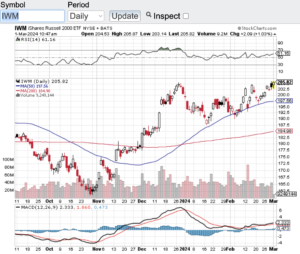
Record highs continue for the Dow Jones Industrial Average (see chart here) and for the S&P 500 (see chart here). In February, the Dow Jones Industrials hit an all-time high of 39282 while for the first time ever, the S&P 500 (see chart here) crossed the 5000 mark trading as high as 5111. These two indexes continue to demonstrate impressive strength along with the Nasdaq Composite (see chart here). It appears that the Nasdaq Composite just might join the Dow Jones Industrials and S&P 500 in hitting a fresh all-time high anytime. The small-cap Russell 2000 (see chart here & below) still has a way to go to reach its all-time high but at least this index is trending up.

Stocks aren’t the only asset class at or near all-time highs, Bitcoin has broken out as of late and has surpassed $60,000 per coin mark. The momentum continues here since Bitcoin ETFs were approved. Now this asset class in not for the faint of heart. As much as Bitcoin continues to rip, sell-offs in this asset class can be dramatic and fast.

So, what is going on with these all-time highs and the “risk on” spirit from institutional investors and retail investors alike? For one, I think the strength of the economy has something do to with this, however, I believe that rampant speculation is also play a role. Especially out of the artificial intelligence sectors as stocks there also continue to make all-time highs. My concern is how long this most recent rally has lasted. For example, the S&P 500 (see chart here) has seen gains in 15 of the last 17 weeks which is rarely seen.

With that being said, as I look at the technical shape of the aforementioned indexes, they are not in overbought territory according to the relative strength index aka the RSI. Many market technicians use this key technical indicator to gage whether a stock or index is overbought. 70 is the key value level of the RSI that would indicate an overbought condition and the major averages are trading below this mark. Now this is only one technical indicator and there are clearly many other factors that determine the state of the markets, but as of now nothing appears to be getting in the way of this impressive months long rally.

Good luck to all πŸ™‚

~George

All Time Highs Continue - Paula Mahfouz

The Bounce Was Indeed Real…

In my November 1st blog, I asked the question was the bounce real? Fast forward to today and indeed the bounce the markets experienced in the early fall not only held but took off to and are nearing all-time highs. The Dow Jones Industrials (see chart here) closed yesterday at 36,245, the S&P 500 (see chart here) closed at 4,594 the Nasdaq Composite (see chart here) closed at 14,305 and the small-cap Russell 2000 (see chart here) finished the month out at 1,862.

It’s truly incredible to see how resilient the markets are considering the current interest rate environment and how inflation continues to impact the consumer. Rising interest rates tend to impact the stock market negatively and inflation impacts the consumer negatively too. So why are the markets approaching all-time highs? Could it be that the economy grew at a faster rate in the 3rd quarter than previously reported? Or could it be that the Federal Reserve may be ready to slow down or pause its current interest rate policy? I am not sure on either front, but what is apparent is that the markets are brushing off the current backdrop of Fed’s economic policy and the ongoing inflationary pressures. One thing I have learned over the years is the trend is your friend and these markets continue to trend up.

That being said, let’s look at a key technical indicator that many traders and investors rely on to see if we are approaching or at overbought conditions. According to the Relative Strength Index aka the RSI both the Dow Jones Industrial Average (see chart here) and the S&P 500 (see chart here) have crossed and are trading above the 70 value level. The 70-value level according to the relative strength index is the beginning of overbought conditions. The Nasdaq Composite (see chart here) and the Russell 2000 (see chart here) are fast approaching the 70-value level. I do want to point out that stocks and indexes can remain overbought for extended periods of time, but I would not be surprised if we see somewhat of a pause or possibly a reversal here in the month of December to this very impressive rally we are currently in.

It’s always a good idea to consult a certified financial advisor before making any adjustments to your portfolio. Good luck to all πŸ™‚

~George

Soft Month For Stocks…

August was a soft month for stocks across the board. The Dow Jones Industrial Average (see chart here) closed the month of August down 2.4%, the S&P 500 (see chart here) fell a modest 1.8%, the Nasdaq Composite (see chart here) gave up 2.2% and the small-cap Russell 2000 (see chart here) fell by over 5%. All things considered, not too shabby considering August historically is one of the weakest months of the year for stocks.

The market performance in August did snap a 5-month winning streak for the S&P 500 and the overall volatility in the stocks also picked up some steam. However, I do think the bulls will take such a modest pullback considering how strong the markets had been since early June. It appears some profit taking occurred in August while overall trading volumes were relatively lower. Now that summer is almost behind us, I expect trading volumes to increase along with the possibility of bigger market swings as we head into fall.

Now that we are in September the question becomes can the market weakness in August turn around in September? I typically look for catalysts to see if market direction will turn and as we head into September overall bullish sentiment has decreased. As contrary as this may sound, bullish sentiment decreasing is usually a bullish sign for the markets. I don’t like participating in markets where the sentiment is overly bullish and this has been the case all summer long, especially with how AI stocks went on a tear over the summer. The Artificial Intelligence sector lifted most indexes and if it wasn’t for the AI craze we have witnessed, I am not so sure if the markets would have enjoyed a multi-month bull run.

I always like to look at the technical shape of the markets as another potential catalyst for market moves. There is nothing really standing out either bullish or bearish. From the relative strength index aka the RSI, to where the moving averages are currently positioned, there is nothing too glaring one way or the other. Not a surprise considering how low the trading volumes were in August and the modest pullback that did occur.

Good luck to all πŸ™‚

~George

Is A Soft Landing Ahead?

For months now stock market pundits have been calling for a recession. Now it appears that a soft landing is ahead. You name it from Wall Street analysts to the media, not a day goes by without hearing the word recession. Well folks the economic data that has been coming out lately is showing just how strong ourΒ  economy remains. The latest gross domestic product (GDP) report Β that was issued last week showed that in the second quarter of this year our economy grew by 2.4% which surprised the street. What’s more is that this the fourth straight quarter of economic expansion. This sure doesn’t sound like a recession to me. Our economy is growing despite the Federal Reserve continuing to raise interest rates. As of now it sure does look like the Federal Reserve is managing these rate hikes to perfection.

The stock market sure likes what it is seeing from the economy. The Dow Jones Industrial Average (see chart here) continues to remain above its recent breakout. The same can be said for the S&P 500 (see chart here), the Nasdaq Composite (see chart here) and the small-cap Russell 2000 (see chart here). As I alluded to in my July blog, it appeared that stocks were on the verge of breaking out. Sure enough, the month of July was a very bullish month not only on the economic front but also for the stock market. One thing I now want to look for now is if stocks are becoming overbought?

As I look at some of the key technical indicators such as the RSI and the Moving Averages technical indicators nothing too alarming there from a technical standpoint. The exception here is both the Dow Jones Industrials (see chart here) and the S&P 500 (see chart here) are flirting with becoming overbought based on the relative strength index aka the RSI. That said, this is no surprise due to how strong the markets performed in month of July. Let’s see if there is a pullback of some sorts here in August or the continuation of this bullish action.

Wishing everyone the best of luck πŸ™‚

~George

Rally Caps Are On!

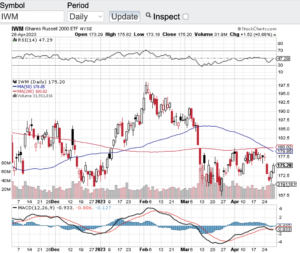
After breaching all moving average support lines including the 200-day, the major averages have their rally caps on! The Dow Jones Industrial Average (see chart here) finished the month of April on a high note. The same can be said for the S&P 500 (see chart here), the Nasdaq Composite (see chart here) and the small-cap Russell 2000 (see chart here and below).

After a slow start to the year including a brief dance with a bear market, stocks have rallied recently to turn green. Even the small-cap Russell 2000 is now green for 2023. So, what is causing the renewed bullish action? In part I think a stronger than expected first quarter earnings results have played a role in this latest bull run along with the Federal Reserve potentially slowing down their interest rate hike program. Positive earnings surprises have come from the health care sector, consumer discretionary and Industrials sector. It’s not just better than expected earnings results, it’s the top line revenue numbers that are also coming in stronger than expected. These data sets are great to see but we still do have some headwinds with inflation remaining high which means the Federal Reserve may not be quite done yet with higher rates.

When I take a look at the technical shape of the markets, there are some encouraging signs that may play a role in the continuation of this latest bull run. It appears that the Dow Jones Industrial Average (see chart here) is breakout out of a month’s long trading channel, as is the S&P 500 (see chart here) and the Nasdaq Composite (see chart here) also appears to be breaking out. I also see that the aforementioned indexes have not yet breached the 70 value level of the Relative Strength Index aka the RSI. The 70-value level of the RSI is considered the beginning of overbought conditions and we are not there yet.

Let’s see how the month of May goes and we will check back on the technical shape of the markets in June. Good luck to all πŸ™‚

~George

Rally Caps Are On! - Paula Mahfouz

Have We Bottomed Yet?

The million-dollar question that is populating the airwaves right now is “have we bottomed yet”? I think the answer lies in two things, first and foremost, the Federal Reserve and whether they will pull back some on their interest rate hikes. And the second question that comes to mind is how corporate earnings perform as this year continues to unfold. Well, the bull case is inflation will continue to ease which should slow down the Fed’s interest rate hikes. The bear case is inflation is still high and that it is going to take time for 2% inflation which is the Federal Reserve’s target. Needless to say, volatility should be in play for the foreseeable future.

The markets did close out the month of January on a high note. Yesterday, the Dow Jones Industrial Average (see chart here) closed up 368 points closing over the 34000 level. The S&P 500 (see chart here) finished the month of January up 59 points, the Nasdaq Composite (see chart here) closed up 190 points and the small-cap Russell 2000 (see chart here) closed up 46 points on the last day of January.

Technically speaking these key indexes also appear ready to run some more. Each of these key indexes are finding support at their respective 20-day, 50-day, 100-day and 200-day moving averages. As I look at the relative strength index aka the RSI, there is yet another technical indicator thatΒ  appears to favor stocks for a continuation to the upside. After a slight retracement of the RSI there are no overbought conditions yet as defined by the RSI.

All in all, I think the stock market is performing quite well considering the headwinds that are currently present. From high inflation to corporate earnings compression, to the ongoing geopolitical backdrop, I think the bulls will take the markets performance so far this year. And as mentioned above, I would not be surprised to see volatility in stocks for the foreseeable future.

Good luck to all πŸ™‚

~George